noise-reducing curtain 30 dB: How Can You Verify True Acoustic Performance?
noise-reducing curtain , advertised as providing 30 dB of sound reduction, may seem like the perfect solution: less noise, more peace and quiet, a more comfortable living space—all without major construction work. That’s exactly the kind of promise that catches your attention when you’re bothered by street noise, neighbors, a stairwell, voices, a noisy restaurant, or a room that’s hard to live in.
But in acoustics, a single number is never enough. A decibel value must always be considered in context: Is it a laboratory measurement or a commercial estimate? Is it an overall value or a peak value? At what frequency? According to which standard? Under what installation conditions? For which specific product?
This guide helps you distinguish between a truly well- soundproof curtain d product and a vague promise. The goal isn't to scare you, but to help you develop the right habits before making a purchase.
1. Can a noise-reducing curtain really reduce noise?
Yes, a acoustic curtain can improve sound quality. But it’s important to distinguish between three effects that are often conflated in product descriptions.
- Sound absorption: The curtain reduces reverberation in the room. The atmosphere becomes more subdued, less harsh, and less tiring.
- Sound attenuation: The curtain reduces some of the sound transmission between two spaces or through an opening.
- Perceived comfort: The user experiences less discomfort, especially if the curtain is heavy, opaque, the right size, and installed correctly.
However, a curtain is no substitute for a solid partition, acoustic double-glazed windows, a soundproof door, or comprehensive soundproofing of the building. A soundproof curtain is a textile solution designed to improve comfort, not a guarantee of total soundproofing.
2. Why the “30 dB” claim needs to be verified
A claimed noise reduction of 30 dB is a very strong claim. It can significantly influence a customer’s purchasing decision, especially when a customer is looking for a solution to a real noise problem.
The problem is that the number alone does not indicate what was actually measured. It could be a maximum value at a specific frequency, a result obtained under highly favorable laboratory conditions, an extrapolation, or a marketing figure that is not sufficiently substantiated.
Before trusting an ad that says “noise-reducing curtain , 30 dB,” be sure to check at least the following:
- the name of the laboratory that conducted the test;
- the measurement standard used;
- the test protocol;
- the frequencies in question;
- the specific product that was tested;
- the dimensions tested;
- installation requirements;
- the difference between lab performance and actual results at home.
Without this information, it is impossible to know whether the stated value represents a reliable measurement, an isolated peak value, or a marketing claim.
3. Rw, frequency, maximum value: Not all decibels mean the same thing
In acoustics, it’s not enough to ask, “How many decibels?” You also have to ask what kind of decibels.
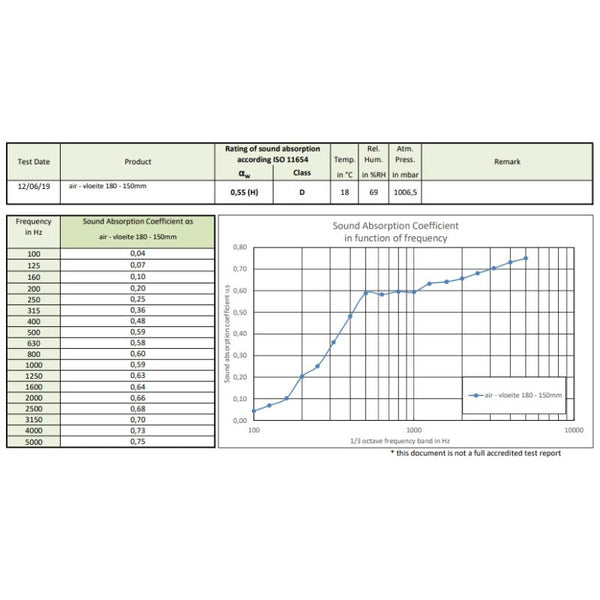
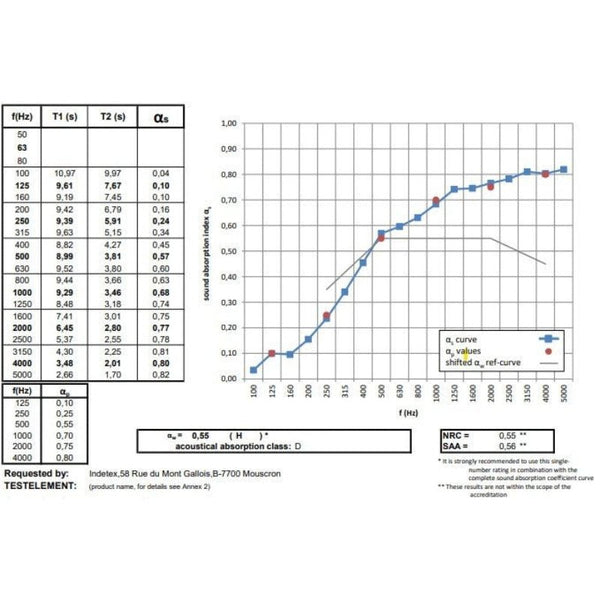
A curtain can provide good sound insulation at certain frequencies—particularly in the midrange and high frequencies—while being less effective at lower frequencies. However, many real-world sources of noise—such as road traffic, motorcycles, trucks, bass, and vibrations—involve low frequencies that are more difficult to attenuate.
We must therefore distinguish between:
- the Rw index, which provides a normalized weighted value;
- frequency-specific values, which show how the product behaves across different audio bands;
- the maximum value, often obtained at a specific frequency;
- the in-situ result, which depends heavily on the installation, the walls, the glazing, the doors, and air leaks.
A maximum value may be useful, but it should not be interpreted as a general guarantee of noise reduction in all situations.
4. thermal curtain, blackout curtain, thick curtain: be careful not to get confused
This is one of the most common misconceptions. A thick, thermal, or blackout curtain can improve the comfort of a room. But that doesn't automatically mean it's a true acoustic curtain.
- thermal curtain s are primarily designed for heating and cooling comfort.
- The primary purpose of a " blackout curtain " is to block light.
- A thick decorative curtain can create a sense of comfort, without necessarily providing measurable soundproofing.
- acoustic curtain s must be designed with noise in mind: mass, structure, continuity, installation, width, height, and treatment of perimeter openings.
If a product page uses terms such as “thermal,” “blackout,” “noise-reducing,” “soundproof,” “sound-absorbing,” and “30 dB” without explaining the acoustic testing protocol, you should exercise caution.
5. Questions to Ask Before Buying a noise-reducing curtain
Before placing an order, you can ask a few simple questions. These will help you quickly distinguish a reputable seller from one making vague promises.
- Which laboratory tested the product?
- According to which standard was the measurement performed?
- Is the acoustic report available?
- Does the stated value correspond to an Rw or a maximum value?
- At what frequencies is this performance achieved?
- Is the product being tested exactly the same as the one being sold?
- What was the installation configuration during the test?
- Did the curtain touch the floor?
- Was there any treatment on the sides or on top?
- What kind of results can we reasonably expect in a real-world setting?
A reputable seller should be able to provide clear answers. If they cannot specify a laboratory, standard, protocol, or measurement conditions, their claims regarding sound performance should be taken with a grain of salt.
6. Why Attitude Makes All the Difference
A " acoustic curtain " functions as a complete system. The fabric alone is not enough. Performance also depends on how the curtain is installed.
The most important points are:
- Width: The curtain should extend well beyond each side of the opening;
- Height: Ideally, it should reach all the way to the floor, with a clean finish;
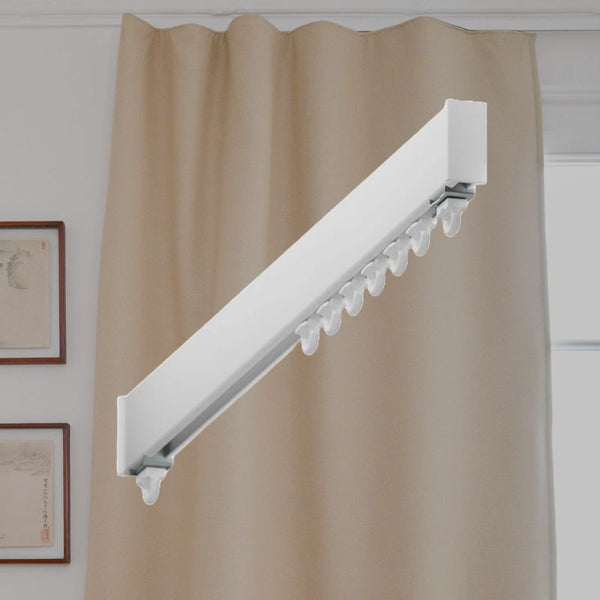
- The Track: It must be suitable for the weight of the curtain;
- peripheral days: the spaces at the top, bottom, and sides reduce efficiency;
- the nature of the noise: low frequencies are more difficult to address;
- The room: walls, ceiling, windows, ventilation, and doors can transmit sound.
A curtain that is too short, too narrow, or improperly installed will perform worse than it would under optimal conditions.
7. Our Approach at NOKOMIS
At NOKOMIS, we prefer a clear, technical approach rather than making over-the-top promises. An effective soundproof curtain must be properly explained, sized, and installed.
Our product sheets list the available performance specifications, but we also remind you that the final results depend on the actual configuration: glazing, walls, installation, height, width, Track, type of noise, and airflow.
For the most demanding needs—especially custom projects—we recommend approaching the project as a complete system: curtain, Track, overhangs, floor-to-ceiling height, and selecting the right product line.
You can view our selection of acoustic curtains here: NOKOMIS acoustic curtains, our Performance PLUS model, or our custom-made Performance PLUS solution.
8. How can you tell if an acoustic promise is too vague?
Please be careful if a product page displays:
- a reduction in decibels with no apparent acoustic effect;
- no identifiable laboratory;
- no measurement standard;
- no frequency specified;
- no clear distinction between thermal, blackout, and soundproof;
- phrases such as “guaranteed effectiveness” without specific conditions;
- customer reviews or satisfaction ratings that are difficult to verify;
- unclear deadlines, return policies, or terms and conditions.
That doesn't necessarily mean the product is ineffective. But it does mean that the claim is worth verifying before you buy.
9. 30 dB noise-reducing curtain : Real Performance or a Marketing Gimmick?
The correct answer is: It depends on the evidence provided.
A value of 30 dB may correspond to the maximum performance measured under specific conditions. However, if it is presented as a general, straightforward, and guaranteed reduction without any technical explanation, it may create unrealistic expectations.
To make the right choice, you should always go back to the basics:
- What measure?
- Which lab?
- Which standard?
- Which product?
- What pose?
- What kind of noise pollution?
- What is a realistic goal?
10. What to Do Before You Buy
If you're looking for a noise-reducing curtain for a bedroom, a door, a window, an office, or a professional space, don't just go for the most impressive number.
Instead, ask:
- a clear technical data sheet;
- intelligible acoustic data;
- installation tips;
- an explanation of the limitations;
- a size that fits your opening;
- A salesperson who can distinguish between comfort, absorption, damping, and insulation.
A good " soundproof curtain " is not just a thick curtain. It is a technical textile solution designed to reduce noise in a specific setting.
FAQ — 30 dB noise-reducing curtain
Can a " noise-reducing curtain " really reduce noise?
Yes, a well-designed and properly installed acoustic curtain can reduce noise pollution and improve acoustic comfort. However, the results depend on the type of noise, the installation, the dimensions, the glazing, the walls, and the air gaps.
What does “30 dB” mean for a soundproof curtain ?
The notation “30 dB” should be interpreted with caution. It is important to determine whether it refers to a maximum value, a value per frequency, an Rw rating, or a marketing estimate. Without a laboratory, standards, and protocols, the figure is difficult to evaluate.
Is a " thermal curtain " also a " soundproof curtain "?
Not necessarily. A thermal curtain is designed to improve thermal comfort. A soundproof curtain must be designed with acoustics in mind, featuring an appropriate structure, weight, installation method, and technical specifications.
What's the best way to set up a " noise-reducing curtain "?
The installation should minimize air gaps and peripheral gaps. It is recommended to include a side overhang, a height that reaches the floor, a Track , and sufficient width to properly cover the opening.
Can a " soundproof curtain " replace acoustic double-pane windows?
No. A sound- soundproof curtain r can improve acoustic comfort, but it is no substitute for acoustic double-pane windows, a heavy partition, or comprehensive building envelope treatment.
Conclusion
noise-reducing curtain s can be an excellent solution for improving the acoustic comfort of an interior. However, any claim regarding noise reduction must always be substantiated.
Before purchasing a curtain advertised as having a sound level of 30 dB, check the testing laboratory, the standard, the testing protocol, the frequencies, the installation conditions, and whether the product sold matches the advertised performance.
At NOKOMIS, we take a straightforward approach: effective acoustic curtains, clearly explained performance specifications, clearly stated limitations, and reliable guidance to help you choose the right solution.
Do you have a soundproof curtain project?
Send us the dimensions of your window, door, or opening, along with some information about the noise pollution. We’ll help you choose a suitable and practical solution.