The short answer: there is no single value that applies to all homes.
A " soundproof curtain " can help improve acoustic comfort when a significant portion of the noise enters through a window, a picture window, or a door. However, the results depend on the type of noise, the opening to be treated, the dimensions of the curtain, its installation, and other transmission paths.
Why can't your results be summed up in a single number?
A performance rating expressed in decibels may correspond to a measurement taken in a laboratory under specific conditions. It does not mean that you will experience exactly the same reduction in noise level in your bedroom or living room.
In a real-world setting, noise can also travel through windows, seals, door and window frames, roller shutter boxes, walls, or the ceiling. The result therefore depends on the layout of the space as well, and not just on the curtain itself.
To learn more: noise-reducing curtain 30 dB: How Can You Verify True Acoustic Performance?
What does the 28.2 dB rating for the Performance PLUS from Nokomis.eu mean?
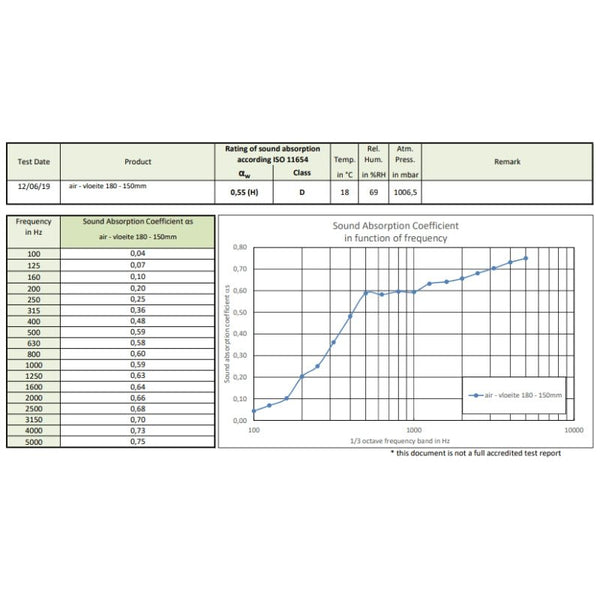
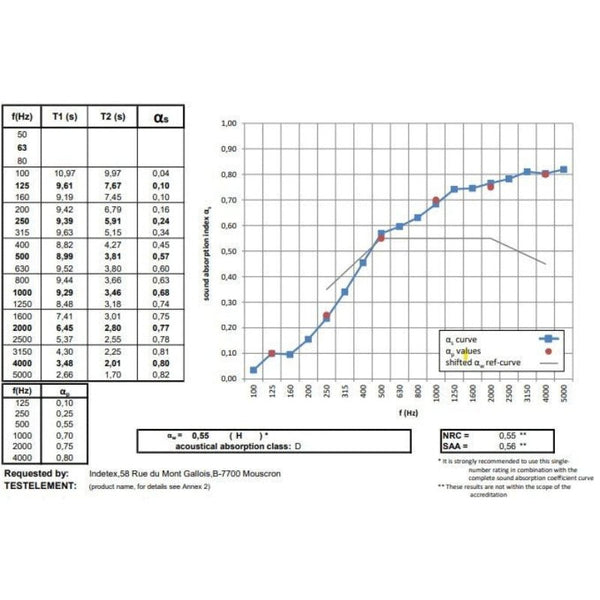
The acoustic performance data provided for the Performance PLUS by Nokomis.eu are based on a test conducted by the Daidalos Peutz laboratory in accordance with the NBN EN ISO 10140-2:2010 standard.
In particular, the report indicates an overall Rw rating of 14 dB and a value of 28.2 dB measured at 5,000 Hz.
The Rw is a comprehensive index calculated from measurements taken at several frequencies. The 28.2 dB figure, however, corresponds to the performance measured at a specific frequency: 5,000 Hz.
This does not mean, therefore, that a noise level of 70 dB in your bedroom will automatically drop to 41.8 dB after installing the curtain.
To learn more about the test: see our article on the acoustic lab report. You can also check out the Performance PLUS product sheet.
What really influences the outcome?
1. The point where the noise enters
If traffic noise seems significantly louder near the window, soundproofing that opening may be a good idea. On the other hand, if a neighbor’s conversations are mainly coming through a shared wall, a curtain in front of the window will not effectively block the main source of noise.
2. The type of noise
A voice, a scooter, a car, or music do not all contain the same frequencies. The result may therefore vary depending on the type of noise encountered.
3. Dimensions and Installation
A curtain that is too short or too narrow leaves more uncovered areas around the opening. A properly sized curtain creates a more favorable setup.
When might a soundproof curtain be particularly useful?
It may be particularly useful when outside noise enters primarily through a window, a picture window, or a door.
In a room exposed to traffic noise, reducing some of the outside noise can help create an environment that is more conducive to rest and sleep.
Depending on the model, the curtain may also offer other benefits, particularly in terms of light blocking and thermal comfort. These benefits are distinct from acoustic performance.
Would you like to see the model NOKOMIS , which has documented acoustic performance?
3 Questions to Ask Yourself Before Buying
- Where does most of the noise come from?
- Is the advertised performance actually documented and explained?
- Will the curtain cover the opening in question properly?
So the right choice isn't necessarily the curtain with the highest rating, but the one with documented performance that truly matches the specific application.
Frequently Asked Questions
How many decibels does a soundproof curtain actually reduce?
There is no universal value. The result depends on the product, the type of noise, the opening, the dimensions, and the installation.
Why doesn't 28.2 dB mean 28.2 dB less at my house?
Because this value was measured at 5,000 Hz in a laboratory setting. In a real-world residential setting, noise consists of multiple frequencies and can also travel through other parts of the building.
Can a " soundproof curtain " reduce traffic noise?
It can help improve acoustic comfort when a significant portion of the noise enters through the window, picture window, or door it covers.
Can a " soundproof curtain " muffle the sounds from neighbors?
It depends on the path the noise takes. If it comes mainly through a door that the curtain covers, the curtain can help improve acoustic comfort. If voices are coming mainly through a shared wall, a curtain placed in front of the window will not address that transmission.
Conclusion
So the right question isn't just, " How many decibels does this curtain reduce?"
But rather: “ What performance was actually measured, and does this solution match the way noise enters my home?”
It is this difference between a laboratory measurement and the actual result in a home that allows you to make a more informed choice of soundproof curtain .
Are you unsure which model to choose or whether a soundproof curtain is right for your specific problem? Describe your situation to us so we can help you find the best solution.